


Beyond Obedience: Why Your Relationship With Your Dog Matters More Than Commands Alone

When we first adopted Athos, my original thinking was probably much the same as most of the dog-training world, and that was really centred around one question: did the dog do what I told the dog to do?
And over time, through the issues, the reactivity, the trainers we worked with and all the other things Athos brought to the table with us, I started to realise that there was probably another question we were not asking nearly enough, which was: what did the dog learn about me while we got there?
Now, don't get me wrong. I teach obedience skills every day, although I generally prefer the word cue rather than command, because to me we're trying to build communication rather than simply issue instructions. Sit, stay, recall, leave it, loose-lead walking, settle, all of those things are useful and some of them are genuinely important for safety.
But do I think we're making a mistake when we use obedience as the main measure of how well somebody has bonded with their dog? Yes, I do.
I've met plenty of dogs who are technically very obedient but are not particularly confident around their handler. Equally, I've met plenty of dogs with fantastic relationships with their owners who have still got a lot of training to do. Those two things are not the same.

Going back to Athos, when we first got him I ended up hiring a number of trainers, and he was very capable of doing a lot of the cues, or commands as I would probably have called them at the time, that he was asked to do. But there's a big difference between a dog being able to perform a behaviour and what that behaviour actually tells us.
If a dog does what we ask, what that tells me is that in that particular moment, in that particular environment and emotional state, the behaviour was available to them. It doesn't really tell me much about how the dog felt while they were doing it, and that is where things become a lot more interesting for me.
Because your dog is not only learning the exercise. They're learning you.
Your dog is learning you as well as the cue
One of the things I say to clients all the time is that dogs are incredibly good at learning patterns, and they're also incredibly good at reading us. So we might think we're teaching recall, but the dog is also learning what normally happens when they come back to us.

Take a really simple dog-park example. If the only time you ever call your dog is when you're leaving, the moment they come back to you the fun ends. They remember that. Or maybe you call them, they take too long to get back, and when they eventually do return you scold them because they ignored you for the previous two minutes.
From your perspective, you're scolding them because they took too long.
From the dog's perspective, they came back to you and got scolded.
Those are not necessarily the same thing.
And this is also where I think people sometimes overestimate the value of just handing the dog a treat. If I give the dog a piece of food for coming back and then immediately end their freedom, or I give them food and then scold them, the treat may not be anywhere near valuable enough to overcome the rest of what just happened.
In learning terms, removing access to something the dog wants can function as negative punishment, while adding something unpleasant such as scolding can function as positive punishment. Those terms tend to sound harsher than they actually are, but the important point is that the dog is learning from the whole consequence, not just the bit we intended to be the reward.
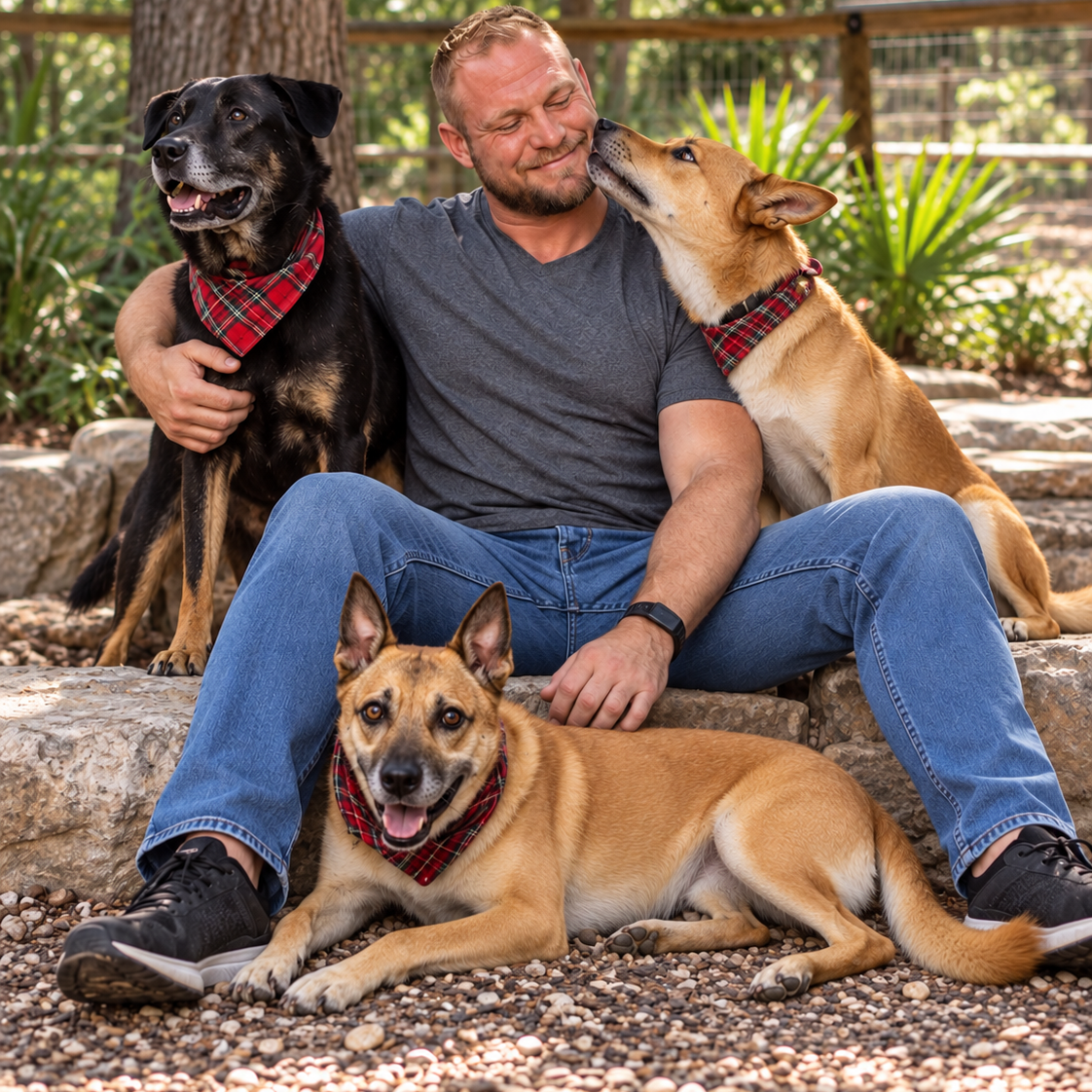
So with my own dogs I'm very deliberate about this. Athos, Aramis or Porthos might be sniffing, exploring or playing together and I'll recall them back to me when there is absolutely no need for them to come back.
They come back, I reinforce the recall, and then I let them go back to whatever they were doing.
Now you might quite reasonably ask, what was the point in that?
Well, the point is that I don't want coming back to me to consistently predict the end of something good. I'm building a history where returning to me is worthwhile, even when the environment is also worthwhile.
And the funny thing about that is it actually creates stronger so-called obedience anyway, because when it genuinely matters and I do need to recall them away from something, coming back to me already has a very strong history behind it.
I see the opposite problem in consultations all the time. Someone will say, “My dog knows recall, but he just won't do it outside.”
And usually they're right, the dog probably does know the cue. But the dog knows the cue in the living room. Then we take the dog outside and suddenly there are other dogs, smells, movement, wildlife, people, traffic and a completely different emotional state. Then the owner is surprised that they don't get exactly the same response.
The dog hasn't necessarily forgotten anything and they certainly haven't suddenly decided to become stubborn. We've changed the entire picture.
That is why I struggle with the idea that dog training is simply about teaching commands. The dog is learning about the environment, their own emotional state and us at exactly the same time. And that's a lot.
How the dog feels while learning matters

I had a really good example of this in puppy class recently.
One of our clients very proudly told me that their dog could do a down.
I said, “That's great. Show me.”
They asked the puppy to lie down and the dog got so excited that it almost did the down in mid-air and just collapsed onto the floor in this ridiculous heap because the whole reinforcement history around that exercise was excitement, food, play and interaction with the owner.
Now, I'm not saying it was the tidiest down I've ever seen in my life, because it absolutely wasn't, but the emotion attached to being asked to do it was pure joy.
Then compare that with another dog I worked with not long before.
The owner told me, “Down is one of the commands my dog knows.”
So I said, “Okay, show me.”
They asked the dog to lie down and nothing happened. Then the owner lifted their hand as though they were about to hit the dog and the dog immediately dropped to the ground and cowered.
Now both of those dogs technically performed a down.
If all we are doing is looking at the end behaviour, then you could tick the same box for both dogs. But the emotional experience of those two dogs is completely different, and I think that distinction matters enormously.
This is not me saying that dogs shouldn't have boundaries. My dogs certainly do. It doesn't mean that rules shouldn't be enforced or that we stand around indefinitely waiting for our dogs to decide when they fancy doing something.
What it means is that how we teach matters.
There is good research behind this as well. Vieira de Castro and colleagues looked at 92 companion dogs attending different training schools that used different proportions of aversive and reward-based methods. The dogs exposed to more aversive methods showed more stress-related behaviours during training, while the high-aversive group also showed greater post-training increases in cortisol and more pessimistic responses in a cognitive-bias task (Vieira de Castro et al., 2020).
And that matters, because what it tells us is that a dog might still be performing the behaviour we asked for while having a very different emotional experience of the training itself.
But beyond the research, there is something much more practical here. A dog can be doing exactly what we ask and still not be okay. That is why when I'm working with a dog I don't just look at whether they did the behaviour. I'm looking at everything around it. How quickly did they recover? Did they choose to come back into the interaction? What happened when they made a mistake? Could they disengage? Could they still think?
And I think one of the most useful questions we can ask ourselves is still, what is my dog learning about me while I teach this?
Not because every training interaction has to be some huge emotional event, because most of the time it isn't. But those interactions happen thousands of times over the lifetime of a dog.
They add up.
And eventually they become the relationship.
Sometimes the right thing is to do less
Porthos is probably the best example of this in my own dogs. He's my youngest, although he's not actually all that young anymore, and he has an incredibly high prey drive. And despite this, there are situations with him where the best thing I can do is not keep telling him what to do.
Sometimes the best thing is just to sit with him, let him sniff, make the situation predictable, give him something to investigate and allow him to decide whether he wants to engage.
Because when a dog is uncertain, or highly stimulated, humans have this tendency to start filling every second with instruction.
"Sit, Look at me, Come, Heel, Leave it, Good boy, Come here, Do this, Don't do that!"

And sometimes I want to know what happens if I stop doing all of that.
Does Porthos choose to explore rather than bolt after something? If he moves away from me, does he look back? If he checks in voluntarily, can I use that rather than immediately issuing another command? Does he choose to come back towards me?
Those voluntary behaviours tell me a huge amount about the dog and about the relationship we have with them.
And when a dog who could quite easily choose the environment decides to involve you without being asked, I value that enormously.
Not because I've managed to make the dog dependent on me. Actually, quite the opposite.
A good bond should make the dog more capable, not less capable without you.
This is something I feel quite strongly about because I think we sometimes confuse dependence with bonding.
If a dog follows somebody from room to room every second of every day, it is not automatically proof of an incredible relationship. Sometimes that absolutely might be affection, but it can also be uncertainty, habit, reinforcement history or difficulty coping without that person.
What I want is a dog who feels secure enough to go away from me. On walks with my own dogs, some of my favourite interactions are actually the ones where very little happens. They'll wander off to sniff something, explore somewhere, maybe move a short distance ahead and then voluntarily come back towards me, check in for a moment and wander off again.
I've not asked them to do that. They're being dogs. But I am still relevant to them. And that's much closer to what I personally want from the relationship.
Now obviously that doesn't mean allowing a dog to disappear 50 metres away regardless of the environment. This is not an argument against management, safety or common sense. It's about giving the dog appropriate autonomy without constantly micromanaging everything they do.

There's some really interesting research around something called the secure-base effect which fits into this really nicely. Horn, Huber and Range looked at dogs performing a problem-solving task under different social conditions. They found that dogs spent longer interacting with the task when their owner was present than when the owner was absent, and an unfamiliar person did not have the same effect (Horn, Huber & Range, 2013).
The owner wasn't solving the problem. They weren't showing the dog what to do. But, their presence itself seemed to help the dog stay engaged. And I love that, because that's very different from dependency.
I don't need Athos, Aramis or Porthos to ask my permission before they investigate every blade of grass. I want them to explore, to make decisions, and even occasionally I want them to get things wrong. But when something becomes difficult or dangerous, I want turning back towards me to be a good option in their mind. Even better, I want them capable of making that decision without me constantly having to tell them.
That's the relationship I'm interested in building.
Your dog is watching you too

We spend a huge amount of time watching dogs. Are their ears forward? Is their tail tucked? Are they licking their lips? Have they shifted their weight backwards? Are they staring? Have they turned their head?
But sometimes we forget that while we're analysing them, they're also watching us.
Dogs are capable of using information from humans when deciding how to respond to uncertain situations, and there has been some really interesting work looking at social referencing.
In one study, Merola, Prato-Previde and Marshall-Pescini presented dogs with an unfamiliar object while either the owner or an unfamiliar person provided positive or negative emotional information. Most of the dogs looked between the person and the object, and when the information was coming from the owner it influenced aspects of the dog's subsequent behaviour towards the object (Merola, Prato-Previde & Marshall-Pescini, 2012).
I think we have to be careful not to oversimplify that. It does not mean that if your dog is anxious, it is because you're anxious. Behaviour is very rarely that simple. But it does mean that we are part of the environment our dogs are processing. And I see that very clearly when I'm working with anxious or reactive dogs, particularly rescue dogs.
Something appears in the environment and immediately the handler tightens the lead, maybe their jaw tightens, their breathing changes, they stop walking, they're saying “It's okay, it's okay, it's okay.” The dog now has even more information to process.
That doesn't mean the owner caused the reaction, but it does mean the owner became part of the picture. There are always two ends of the lead.
One of my favourite bonding activities is me doing less than the dog

I do this a lot with Porthos in particular, and it's scentwork. Now, there are incredibly sophisticated and impressive ways of doing scentwork. What I do with Porthos is considerably less impressive.
I ask him to come into middle and stand between my legs. I take his ball and throw it into an area of longer grass, then I make him wait for maybe ten or twenty seconds before I release him to find it. By that point he actually has to search and he's got to use his nose. And, quite honestly, by that stage I'm normally not entirely sure where the ball is either.
That is part of why I like it, I've set the problem up and I can observe him, support him. But the relationship changes slightly because, for once, he is the expert. Porthos has a nose that I simply do not have.
If he tells me the ball went left while I'm convinced I threw it to the right, I should probably shut up and follow him because he knows better than I do. And there is something really valuable in that. He gets to investigate, make decisions and solve the problem rather than constantly waiting for another instruction from me.
There's research into nosework that supports some of this as well. Duranton and Horowitz compared dogs doing nosework with dogs doing heelwork and found that the nosework group showed a more positive judgement bias afterwards. The authors discussed both the opportunity to perform a natural olfactory behaviour and the increased autonomy involved as possible contributors (Duranton & Horowitz, 2019).
Now, their scentwork was considerably more structured than me throwing Porthos's ball into some grass and then losing track of it, but the principle is one I really like. Give the dog something they are naturally better at than we are, and let them do it.
I see the same thing with problem-solving games, as long as we actually give the dog space to solve the problem. If I put a simple barrier between a dog and something they want, my instinct as a trainer shouldn't always be to immediately show them the answer.
It should be to let them think, try one way, get it wrong, try another way, move around it, try something else. We humans are terrible for jumping in because we don't want the dog to struggle. It's basically helicopter parenting for dogs.
But a small amount of appropriate frustration with a problem the dog is actually capable of solving can be hugely useful.
Good training is not about removing every challenge from the dog's life. It's about making sure the challenge is appropriate for the dog in front of you.
So what does bonding actually look like?

Probably much less dramatically than people imagine. It isn't about staring lovingly into your dog's eyes for twenty minutes, and it isn't about your dog following you into every room of the house, and it definitely isn't about perfect obedience. For me, I would start paying attention to the ordinary things.
Notice how often your dog chooses to check in with you rather than only noticing when they respond to something you've asked them to do.
Make sure that coming back to you doesn't always mean their freedom ends. Recall them, reinforce it and sometimes send them straight back to whatever they were enjoying.
Give your dog opportunities to do things they're actually good at, whether that's scentwork, exploration, play, swimming, agility, problem-solving or simply investigating somewhere new.
If your dog is worried, don't immediately ask them for a performance. A frightened dog does not necessarily need to sit or heel. Sometimes they need distance, information and somebody they trust beside them.
Let them occasionally work something out without micromanaging every decision.
And look at recovery.
A dog getting excited or worried isn't automatically a problem. The much more useful question is how effectively they can come back down afterwards.
Now, none of that replaces training, but it makes the training more meaningful. And of course the so-called obedience side still matters.
I don't want anybody reading this thinking Fraser has suddenly decided recall is not important, because that's definitely not what I'm saying.
A reliable recall can save your dog's life. Leave it might stop your dog eating rat poison.

Being able to walk on a lead without having your shoulder ripped out of its socket is obviously quite useful. And being able to settle in a bar while you have a pint without your dog climbing onto the people at the next table is incredibly important. Especially to me.
But I do see them as methods of communication rather than proof of the relationship. And one of the interesting things is that when the relationship underneath the training gets stronger, those cues tend to become stronger as well.
The stronger the partnership becomes, the less you feel that you have to micromanage every second of your dog's existence.
I had a lovely reminder of that with Athos recently.
I had him with me in the office, up at our facility and one of our junior trainers said to me, “Fraser, I've just realised I haven't actually heard you give Athos any commands.”
And genuinely, that was one of the biggest compliments somebody could have given me.
Because it made me stop and think. This was the dog who started all of this. Noble Canine Oasis probably wouldn't exist without Athos's behaviour problems. He was the reactive dog I hired trainer after trainer to help me with, the dog I felt I constantly had to manage because he could be a liability, and ultimately the dog who led me to leave corporate life and become who I am today. And now he makes good decisions, decides to follow me, to be with me, who is equally happy being by himself, settles when nothing is happening, and reads what I'm doing so I don't have to constantly tell him where to be or what to do.
This isn't me boasting about my dog, it's about the fact that Athos went from being a dog I thought needed to be obedient and listen to me all the time to being the dog I probably have the strongest relationship I've ever had with an animal in my life. And it was that relationship that helped him the most, not the obedience.
So ultimately what I would like people to take from this article is not that we should stop asking, “Does my dog listen to me?” That question still matters.
But I think we should also ask:
“What does my dog predict will happen when they turn to me?”
If the answer is clarity, safety, information, reinforcement and occasionally just somebody worth being around, then you're probably doing something right.
Beyond the Bond
This is a subject I could talk about for a very, very long time, which is exactly why I'm going to go into it properly in our next Noble Canine Academy seminar.
On Friday 23 October 2026, I'll be running a free live online seminar called:
Beyond the Bond
The Science of a Stronger Relationship With Your Dog Register for Beyond the Bond

We're going to look much more deeply at the things I've touched on here: trust, reinforcement history, communication, emotional state, choice, agency, autonomy and the practical things we can actually do to strengthen the relationship underneath the training.
If this article has made you look at even one interaction with your dog slightly differently, I think you'll enjoy the seminar.
It's completely free, so have a look, sign up and come and join us on Friday 23 October.
References
Vieira de Castro, A. C., Fuchs, D., Morello, G. M., Pastur, S., de Sousa, L. & Olsson, I. A. S. (2020). Does training method matter? Evidence for the negative impact of aversive-based methods on companion dog welfare. PLOS ONE, 15(12), e0225023.https://doi.org/10.1371/journal.pone.0225023
Horn, L., Huber, L. & Range, F. (2013). The Importance of the Secure Base Effect for Domestic Dogs – Evidence from a Manipulative Problem-Solving Task. PLOS ONE, 8(5), e65296.https://doi.org/10.1371/journal.pone.0065296
Merola, I., Prato-Previde, E. & Marshall-Pescini, S. (2012). Dogs' Social Referencing towards Owners and Strangers. PLOS ONE, 7(10), e47653.https://doi.org/10.1371/journal.pone.0047653
Duranton, C. & Horowitz, A. (2019). Let me sniff! Nosework induces positive judgment bias in pet dogs. Applied Animal Behaviour Science, 211, 61–66.https://doi.org/10.1016/j.applanim.2018.12.009


Comments